I didn’t grow up making anything special for Easter besides the usual ham and deviled eggs. But once I had kids, I started wanting to make the holiday feel a little more festive. That’s when I came up with this coconut cake topped with those pastel robin eggs you see everywhere in spring.
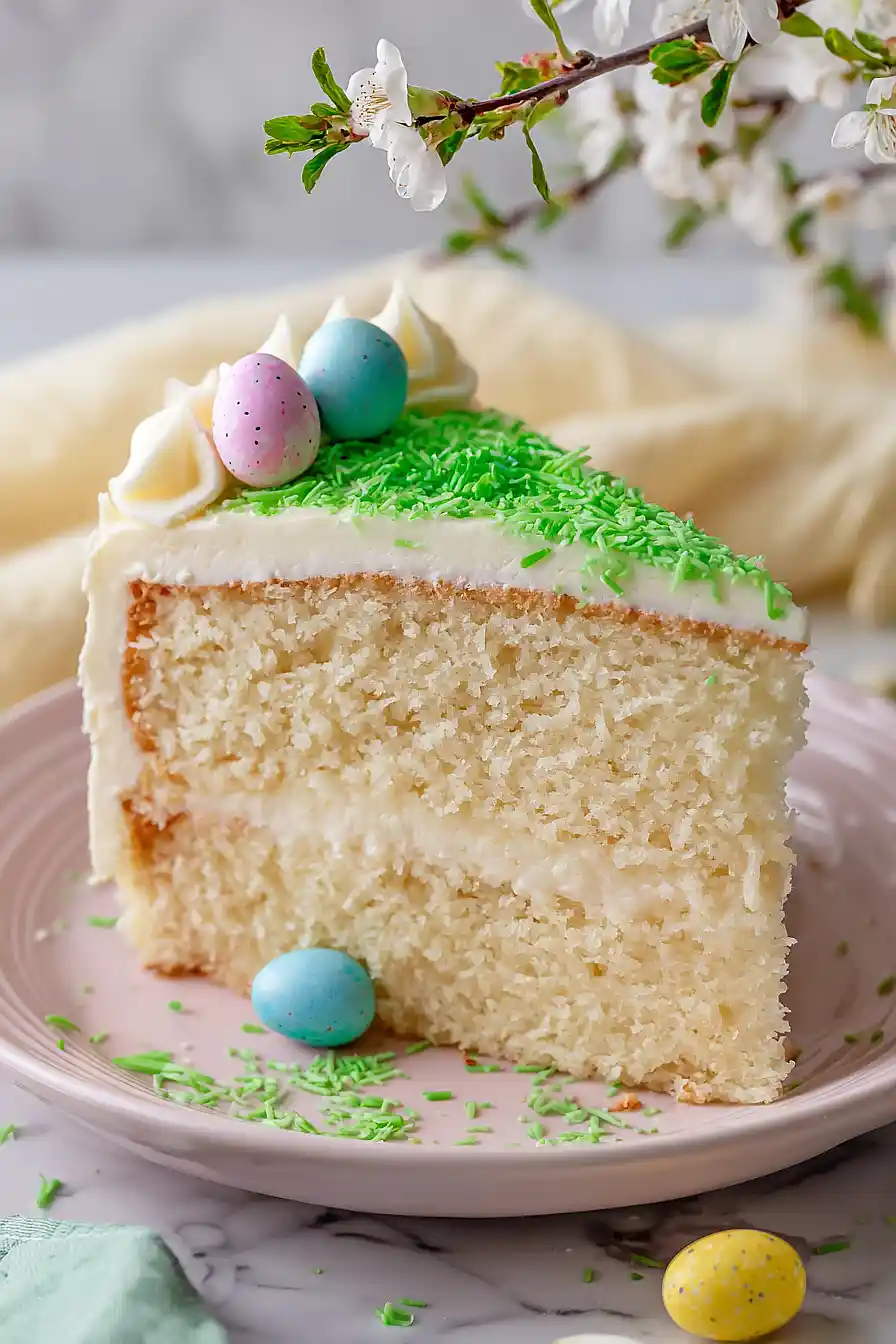
The cake itself is soft and has just a hint of coconut flavor—not too much, so even people who aren’t coconut fanatics will like it. And the mascarpone frosting? It’s rich and creamy without being overly sweet. The best part is pressing the shredded coconut and candy eggs on top. My kids love helping with that part, even if half the robin eggs disappear before they make it onto the cake.

Why You’ll Love This Coconut Easter Cake
- Perfect for spring celebrations – This festive cake is ideal for Easter gatherings, baby showers, or any springtime party where you want to impress your guests with something special.
- Rich, creamy frosting – The mascarpone buttercream is smooth and luxurious, giving you that bakery-quality taste right at home.
- Fun to decorate – The coconut ‘grass’ and robin egg candies make decorating this cake easy and enjoyable, even if you’re not a professional baker.
- Moist, tender crumb – This cake stays soft and delicious for days, making it great for preparing ahead of your celebration.
What Kind of Mascarpone Should I Use?
For this coconut Easter cake, any good quality mascarpone will work perfectly in your frosting. You’ll find mascarpone in the specialty cheese section of most grocery stores, usually near the cream cheese or in the Italian foods aisle. Make sure your mascarpone is fresh and hasn’t been sitting in your fridge for too long – it should smell clean and slightly sweet, not sour. If you can’t find mascarpone or it’s too pricey, you can substitute it with an equal amount of cream cheese, though the frosting will have a slightly tangier flavor instead of that smooth, buttery taste mascarpone brings to the table.
Options for Substitutions
This cake is pretty forgiving when it comes to swapping ingredients:
- Mascarpone: If you can’t find mascarpone, cream cheese works great as a substitute. Just make sure it’s at room temperature so it blends smoothly into your frosting.
- Milk: Any milk you have on hand will work – whole milk, 2%, or even buttermilk. If using buttermilk, reduce the baking powder to 2 teaspoons since buttermilk adds extra lift.
- Vanilla essence: You can use vanilla extract instead of essence – they’re pretty much interchangeable. Or try almond extract for a different flavor profile, but use half the amount since it’s stronger.
- Robin egg candy: These seasonal candies can be swapped with any small egg-shaped candies, jelly beans, or even chocolate eggs. You could also skip them and decorate with fresh flowers or other spring decorations.
- Coconut: Not a fan of coconut? Leave it out entirely or replace it with chopped almonds or crushed graham crackers for texture on top of the frosting.
- Butter: For both the cake and frosting, you can use margarine in equal amounts, though butter gives better flavor. Make sure whatever you use is at room temperature for the frosting.
Watch Out for These Mistakes While Baking
The biggest mistake when making layer cakes is not letting your cake layers cool completely before frosting – warm cake will melt the mascarpone frosting and cause it to slide right off, creating a messy disaster.
Another common error is overmixing the batter once you add the flour, which develops too much gluten and results in a dense, tough cake instead of a light, tender crumb – mix just until the flour disappears.
To prevent your cake layers from doming in the middle, make sure your oven temperature is accurate (use an oven thermometer if needed) and avoid opening the oven door during the first 20 minutes of baking.
When dyeing the coconut green, add the food coloring one drop at a time and mix well between additions, since it’s much easier to add more color than to fix coconut that’s turned neon green.

What to Serve With Coconut Easter Cake?
This coconut cake is pretty rich and sweet on its own, so I like to keep things simple on the side. A cup of hot coffee or tea is perfect for balancing out the sweetness of the mascarpone frosting and all that powdered sugar. If you’re serving this at an Easter brunch, it pairs nicely with fresh berries like strawberries or raspberries, which add a little tartness to cut through the richness. You could also serve it with a scoop of vanilla ice cream if you really want to go all out for dessert.
Storage Instructions
Store: Keep your coconut Easter cake covered in the fridge for up to 4 days. The mascarpone frosting needs to stay cold, so don’t leave it sitting out at room temperature for more than a couple hours. I like to add the robin egg candies right before serving so they don’t get soft from the moisture.
Freeze: You can freeze the unfrosted cake layers wrapped tightly in plastic wrap for up to 3 months. I don’t recommend freezing the finished cake with the mascarpone frosting and decorations, as the texture won’t be quite the same when it thaws.
Serve: Take the cake out of the fridge about 30 minutes before serving so the frosting softens up a bit. It tastes so much better at cool room temperature rather than straight from the fridge. If you froze the cake layers, let them thaw in the fridge overnight before frosting and decorating.
| Preparation Time | 90-120 minutes |
| Cooking Time | 25-30 minutes |
| Total Time | 115-150 minutes |
| Level of Difficulty | Medium |
| Servings | 12 slices |
Estimated Nutrition
Estimated nutrition for the whole recipe (without optional ingredients):
- Calories: 6700-7300
- Protein: 70-85 g
- Fat: 320-360 g
- Carbohydrates: 950-1050 g
Ingredients
For the cake:
- 7 oz butter (I like Kerrygold unsalted butter for this)
- 1 3/4 cups sugar
- 1 tsp salt
- 2 1/2 tsp baking powder
- 3 tsp vanilla extract
- 1/2 tsp coconut extract
- 4 large eggs (room temperature, about 70°F)
- 2 large egg yolks
- 2 1/4 cups flour (I always use King Arthur all-purpose flour)
- 1 1/2 cups milk
For the frosting:
- 12 oz mascarpone
- 6 oz butter (softened to room temperature)
- 4 tsp vanilla extract
- 5 1/2 cups powdered sugar (sifted to remove lumps)
For the decoration:
- 4 oz coconut (I use Baker’s sweetened flaked coconut)
- green food coloring
- 12 oz robin egg candy
Step 1: Prepare Mise en Place and Preheat Oven
- 4 large eggs
- 2 large egg yolks
- 2 1/4 cups flour
- 5 1/2 cups powdered sugar
Preheat your oven to 350°F.
While it heats, gather all ingredients and bring the 4 large eggs and 2 egg yolks to room temperature (about 70°F)—this ensures even mixing and a more tender crumb.
Measure out the flour, sift the powdered sugar to remove lumps, and have all other ingredients ready.
Grease and flour two round cake pans (8 or 9-inch), or line them with parchment paper for easier removal.
Step 2: Cream Butter and Build the Cake Batter Base
- 7 oz butter
- 1 3/4 cups sugar
- 1 tsp salt
- 2 1/2 tsp baking powder
- 4 large eggs
In a large mixing bowl, cream together the 7 oz butter, sugar, salt, and baking powder for about 5 minutes until the mixture is light, fluffy, and pale—this incorporates air for a tender cake.
Beat in the eggs one at a time, making sure each is fully incorporated before adding the next.
I like to scrape down the bowl between additions to ensure even mixing.
This method creates a stable emulsion that will hold more air and give you a beautiful, light crumb.
Step 3: Finish Batter and Bake the Cakes
- 2 1/4 cups flour
- 1 1/2 cups milk
- 2 large egg yolks
- 3 tsp vanilla extract
- 1/2 tsp coconut extract
Alternate adding the flour and milk to the creamed mixture in stages—start with about one-third of the flour, then half the milk, then another third of the flour, then the remaining milk, and finish with the final third of flour.
Mix gently between additions to avoid overdeveloping the gluten.
Stir in the 2 egg yolks and both vanilla extracts (3 tsp vanilla extract and 1/2 tsp coconut extract) until just combined.
Divide the batter evenly between the prepared pans and bake for 25-30 minutes until a toothpick inserted in the center comes out clean.
Cool the cakes in their pans for 10 minutes, then turn them out onto wire racks to cool completely—this prevents them from becoming dense and ensures clean layers for stacking.
Step 4: Prepare the Mascarpone Buttercream Frosting
- 12 oz mascarpone
- 6 oz butter
- 5 1/2 cups powdered sugar
- 4 tsp vanilla extract
While the cakes cool, whip together the mascarpone and 6 oz softened butter in a clean bowl for about 5 minutes until light and fluffy.
Gradually add the sifted powdered sugar and 4 tsp vanilla extract, mixing until the frosting reaches a spreadable consistency.
I like to do this by hand with a whisk or use an electric mixer on medium speed—this prevents overworking the mascarpone, which can become grainy if whipped too vigorously.
The frosting should be smooth, creamy, and hold its shape.
Step 5: Assemble and Frost the Cake
- cooled cakes from Step 3
- mascarpone buttercream from Step 4
Once the cakes from Step 3 are completely cool, place one layer on a serving plate or cake stand and spread a generous layer of mascarpone frosting from Step 4 on top.
Stack the second cake layer and apply frosting to the top and sides, creating an even crumb coat.
Chill the frosted cake for 20 minutes—this firms up the frosting and makes it easier to apply any decorative details.
Step 6: Prepare Coconut Topping and Final Decoration
- 4 oz coconut
- green food coloring
- 12 oz robin egg candy
- remaining mascarpone buttercream from Step 4
While the cake chills, place the 4 oz sweetened flaked coconut in a small bowl and add a few drops of green food coloring, stirring well until the coconut is evenly dyed a soft green.
Remove the cake from the chill and, if desired, pipe frosting flowers or rosettes on top using the remaining frosting from Step 4 and a piping bag with a decorative tip.
Generously coat the top with the green coconut and arrange the 12 oz robin egg candies decoratively on top, pressing them gently into the frosting to secure them.
Step 7: Final Chill and Serve
Chill the finished cake for at least 30 minutes before serving to allow the frosting to set and the flavors to meld.
The cake can be made a day ahead and stored in an airtight container in the refrigerator—just add the fresh frosting decorations and candies a few hours before serving for the best presentation.

Easy Coconut Easter Cake
Ingredients
For the cake
- 7 oz butter (I like Kerrygold unsalted butter for this)
- 1 3/4 cups sugar
- 1 tsp salt
- 2 1/2 tsp baking powder
- 3 tsp vanilla extract
- 1/2 tsp coconut extract
- 4 large eggs (room temperature, about 70°F)
- 2 large egg yolks
- 2 1/4 cups flour (I always use King Arthur all-purpose flour)
- 1 1/2 cups milk
For the frosting
- 12 oz mascarpone
- 6 oz butter (softened to room temperature)
- 4 tsp vanilla extract
- 5 1/2 cups powdered sugar (sifted to remove lumps)
For the decoration
- 4 oz coconut (I use Baker's sweetened flaked coconut)
- green food coloring
- 12 oz robin egg candy
Instructions
- Preheat your oven to 350°F. While it heats, gather all ingredients and bring the 4 large eggs and 2 egg yolks to room temperature (about 70°F)—this ensures even mixing and a more tender crumb. Measure out the flour, sift the powdered sugar to remove lumps, and have all other ingredients ready. Grease and flour two round cake pans (8 or 9-inch), or line them with parchment paper for easier removal.
- In a large mixing bowl, cream together the 7 oz butter, sugar, salt, and baking powder for about 5 minutes until the mixture is light, fluffy, and pale—this incorporates air for a tender cake. Beat in the eggs one at a time, making sure each is fully incorporated before adding the next. I like to scrape down the bowl between additions to ensure even mixing. This method creates a stable emulsion that will hold more air and give you a beautiful, light crumb.
- Alternate adding the flour and milk to the creamed mixture in stages—start with about one-third of the flour, then half the milk, then another third of the flour, then the remaining milk, and finish with the final third of flour. Mix gently between additions to avoid overdeveloping the gluten. Stir in the 2 egg yolks and both vanilla extracts (3 tsp vanilla extract and 1/2 tsp coconut extract) until just combined. Divide the batter evenly between the prepared pans and bake for 25-30 minutes until a toothpick inserted in the center comes out clean. Cool the cakes in their pans for 10 minutes, then turn them out onto wire racks to cool completely—this prevents them from becoming dense and ensures clean layers for stacking.
- While the cakes cool, whip together the mascarpone and 6 oz softened butter in a clean bowl for about 5 minutes until light and fluffy. Gradually add the sifted powdered sugar and 4 tsp vanilla extract, mixing until the frosting reaches a spreadable consistency. I like to do this by hand with a whisk or use an electric mixer on medium speed—this prevents overworking the mascarpone, which can become grainy if whipped too vigorously. The frosting should be smooth, creamy, and hold its shape.
- Once the cakes from Step 3 are completely cool, place one layer on a serving plate or cake stand and spread a generous layer of mascarpone frosting from Step 4 on top. Stack the second cake layer and apply frosting to the top and sides, creating an even crumb coat. Chill the frosted cake for 20 minutes—this firms up the frosting and makes it easier to apply any decorative details.
- While the cake chills, place the 4 oz sweetened flaked coconut in a small bowl and add a few drops of green food coloring, stirring well until the coconut is evenly dyed a soft green. Remove the cake from the chill and, if desired, pipe frosting flowers or rosettes on top using the remaining frosting from Step 4 and a piping bag with a decorative tip. Generously coat the top with the green coconut and arrange the 12 oz robin egg candies decoratively on top, pressing them gently into the frosting to secure them.
- Chill the finished cake for at least 30 minutes before serving to allow the frosting to set and the flavors to meld. The cake can be made a day ahead and stored in an airtight container in the refrigerator—just add the fresh frosting decorations and candies a few hours before serving for the best presentation.

