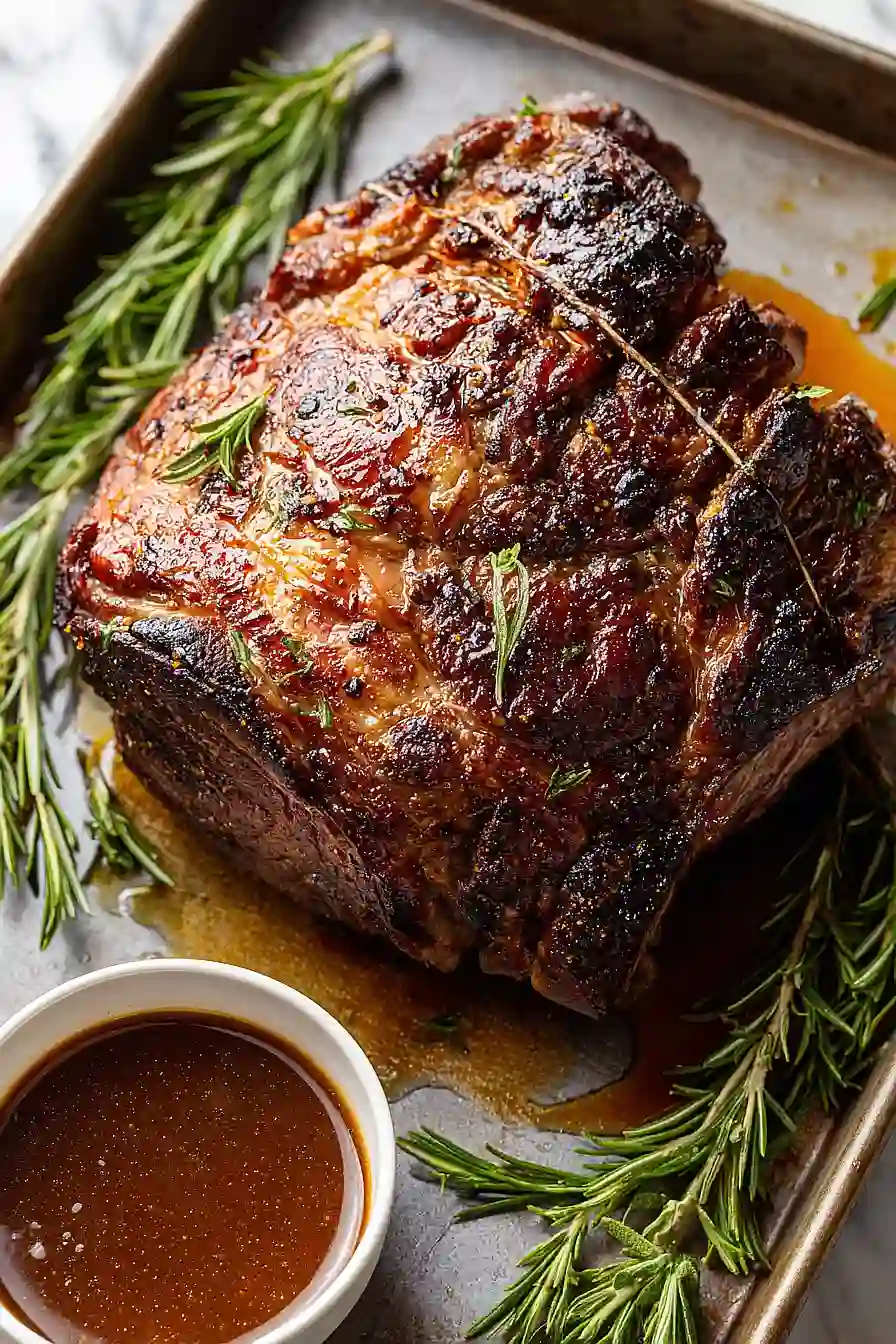
Prime rib feels like one of those fancy restaurant dishes you shouldn’t attempt at home. But honestly? It’s way easier than you think. The key is that gorgeous au jus—the rich, savory drippings that make every slice taste even better.
I used to be scared of cooking prime rib. All that money on a piece of meat, and what if I messed it up? But once I learned the basics, I realized it’s actually pretty forgiving. You season it, roast it low and slow, and let it rest. The au jus makes itself from the pan drippings while the meat rests.
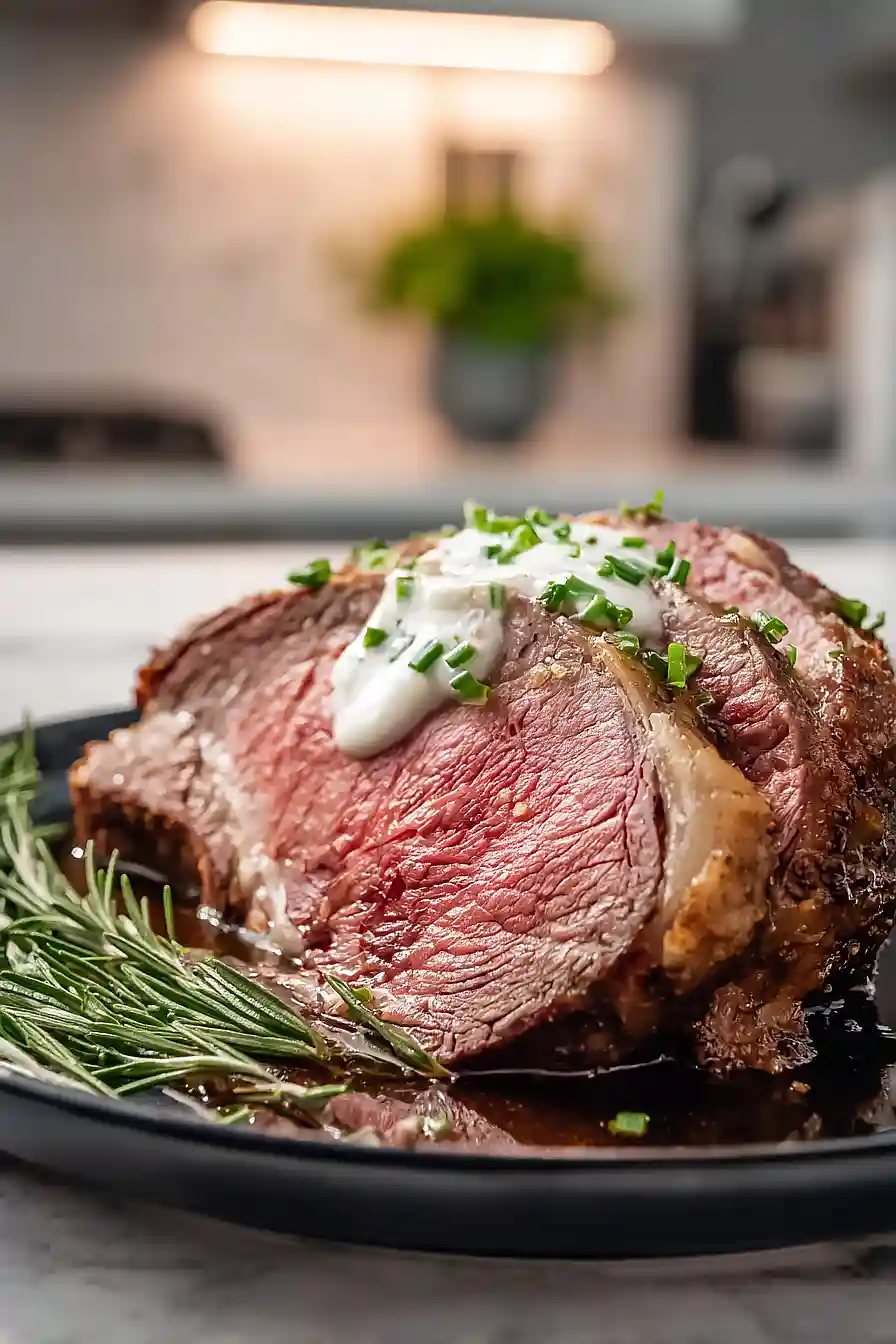
Now it’s my go-to for Christmas dinner and special occasions. Everyone thinks you spent hours in the kitchen, but really, the oven does most of the work. Plus, you get to feel like a fancy chef serving up slices with that perfect pink center and a little dish of au jus on the side.

Why You’ll Love This Prime Rib
- Restaurant-quality results at home – This recipe walks you through making a perfectly cooked prime rib with rich au jus that tastes like something you’d pay top dollar for at a steakhouse.
- Impressive for special occasions – Prime rib is the kind of dish that makes holidays and celebrations feel extra special, and it’s easier to pull off than you might think.
- Flavorful homemade au jus – Instead of using a packet, you’ll make a deeply savory au jus from scratch using beef bones and aromatics that takes this dish to the next level.
- Feeds a crowd – A 6-pound roast is perfect for family gatherings or dinner parties, giving you plenty of tender, juicy slices to go around.
What Kind of Prime Rib Should I Use?
When you’re at the butcher counter, you’ll want to ask for a bone-in prime rib roast, which is also called a standing rib roast. The best cut comes from the small end (ribs 10-12), as it tends to be more tender and has a better meat-to-fat ratio than the large end. Make sure to ask your butcher to remove the bones and tie them back onto the roast – this makes carving so much easier while still giving you all that bone-in flavor during cooking. If prime grade is out of your budget, choice grade works perfectly fine and will still give you a delicious, juicy roast.
Options for Substitutions
While prime rib is the star here, you have some flexibility with the supporting ingredients:
- Prime rib roast: This is one ingredient you really can’t substitute – prime rib is what makes this dish special. However, you can ask your butcher for a standing rib roast if ‘prime rib’ isn’t available, as they’re the same cut.
- Oxtails or beef bones: If oxtails are hard to find or pricey, use any meaty beef bones like short ribs, marrow bones, or knuckle bones. The goal is to add body and richness to your au jus.
- Red wine: Any dry red wine works here – cabernet, merlot, or even pinot noir. In a pinch, you can skip it and add an extra 1/2 cup of beef stock plus a splash of balsamic vinegar.
- Better than Bouillon: A regular beef bouillon cube works fine as a substitute. You can also leave it out if your beef stock is already flavorful.
- Fresh thyme: Use 1 teaspoon of dried thyme if you don’t have fresh sprigs on hand. Add it at the same time you’d add the fresh.
- Diamond Crystal Kosher salt: If using Morton’s Kosher salt (which is denser), reduce the amount to 2 tablespoons as noted, or use 1 1/2 tablespoons of regular table salt.
Watch Out for These Mistakes While Cooking
The biggest mistake when cooking prime rib is not bringing it to room temperature before roasting – take it out of the fridge at least 2 hours beforehand so it cooks evenly from edge to center.
Many home cooks also skip using a meat thermometer and rely on timing alone, which can lead to an overcooked or undercooked roast, so invest in an instant-read thermometer and pull the roast when it hits 120°F for medium-rare (it’ll climb to 130°F while resting).
Don’t forget to let your prime rib rest for at least 20-30 minutes after cooking, as cutting into it too soon will cause all those delicious juices to run out onto your cutting board instead of staying in the meat.
For the au jus, avoid the temptation to rush the browning process on those oxtails and bones – taking the time to get a deep, dark sear will give you a richer, more flavorful sauce that’s worth the extra effort.
What to Serve With Prime Rib?
Prime rib is a showstopper main course, so I like to keep the sides classic and simple to let the beef shine. Creamy mashed potatoes or a loaded baked potato are perfect for soaking up that rich au jus, and roasted vegetables like carrots, Brussels sprouts, or green beans add a nice balance to the meal. Yorkshire pudding is another traditional favorite that’s basically made for dunking in the au jus, and it’s easier to make than you might think. Don’t forget a simple horseradish cream sauce on the side – just mix prepared horseradish with sour cream and a squeeze of lemon for a tangy kick that cuts through the richness of the meat.
Storage Instructions
Store: Leftover prime rib should be wrapped tightly in foil or plastic wrap and kept in the fridge for up to 4 days. Store the au jus separately in an airtight container so you can reheat it easily. The fat will solidify on top of the au jus when cold, which you can skim off or just stir back in when reheating.
Freeze: Both the prime rib and au jus freeze really well for up to 3 months. Slice the meat before freezing so you can grab just what you need, and freeze the au jus in smaller portions. I like using ice cube trays for the au jus so I can pop out just enough for sandwiches or a quick meal.
Reheat: The best way to reheat prime rib without drying it out is to warm it gently in the au jus on the stovetop over low heat. You can also reheat slices in the oven at 250°F until warmed through, then spoon hot au jus over top. For the au jus alone, just warm it on the stove and give it a good stir.
| Preparation Time | 15-20 minutes |
| Cooking Time | 160-250 minutes |
| Total Time | 175-270 minutes |
| Level of Difficulty | Medium |
Estimated Nutrition
Estimated nutrition for the whole recipe (without optional ingredients):
- Calories: 5800-6600
- Protein: 580-650 g
- Fat: 390-460 g
- Carbohydrates: 55-80 g
Ingredients
For the prime rib:
- 3 tbsp Diamond Crystal kosher salt
- 1 (6 lb) prime rib or beef rib roast (bring to room temperature before cooking)
- 3 tbsp olive oil
- 1 tbsp coarse black pepper (freshly ground preferred)
For the au jus:
- salt to taste
- 1 large onion
- 1/2 cup dry red wine
- 1 tbsp tomato paste
- 1 tsp Better than Bouillon beef base
- 6 cups low-sodium beef stock
- 1 large bay leaf
- 3 lb oxtails, neck bones, or meaty beef bones (I use a mix for deeper flavor)
- 3 celery ribs (roughly chopped)
- pepper to taste
- 5 garlic cloves (minced)
- 2 large carrots (roughly chopped)
- 2 sprigs thyme
Step 1: Season and Dry-Brine the Prime Rib Roast
- 1 (6 lb) prime rib or beef rib roast (bring to room temperature before cooking)
- 3 tbsp Diamond Crystal kosher salt
- 1 tbsp coarse black pepper (freshly ground preferred)
Pat the prime rib roast dry and season it generously on all sides with 3 tablespoons of kosher salt and 1 tablespoon of coarse black pepper.
Place the seasoned roast on a wire rack set over a baking sheet.
Refrigerate uncovered overnight to allow the seasoning to penetrate and to dry out the surface for better browning.
Step 2: Bring Roast to Room Temperature
Remove the seasoned prime rib roast from the refrigerator about 4–5 hours before cooking to let it come to room temperature.
This ensures even roasting.
Step 3: Slow Roast the Prime Rib
- seasoned prime rib or beef rib roast from Step 1
Preheat your oven to 250°F and position a rack in the middle of the oven.
Insert a digital probe thermometer into the center of the roast and set it to alert at 120°F.
Place the roast in the oven and cook until the internal temperature reaches 120°F, which takes roughly 2 1/2 to 3 1/2 hours.
Once done, tent the roast loosely with foil and let it rest for 30 minutes.
Step 4: Broil the Prime Rib for a Crust
- rested prime rib roast from Step 3
Adjust your oven by placing one rack on the lowest level and covering it with foil to catch drippings.
Set another rack in the middle position and turn on the broiler.
Transfer the rested roast onto the middle rack and broil, turning with tongs to brown all sides well, about 2 minutes per side.
Remove the roast, transfer to a carving board, remove the strings and bones, and slice for serving.
I find that broiling right after resting really enhances the rich, caramelized crust.
Step 5: Brown the Bones for Au Jus
- 3 tbsp olive oil
- 3 lb oxtails, neck bones, or meaty beef bones (I use a mix for deeper flavor)
While the roast cooks, heat a large heavy pot or Dutch oven over medium heat.
Add 3 tablespoons of olive oil.
Pat dry the oxtails, neck bones, or meaty beef bones, and add them to the pot.
Sear the bones, turning occasionally, until well browned on all sides, about 10 minutes.
Step 6: Build the Aromatic Base for Au Jus
- 1 tbsp tomato paste
- 1 large onion
- 2 large carrots (roughly chopped)
- 3 celery ribs (roughly chopped)
- 3 lb browned oxtails, neck bones, or meaty beef bones from Step 5
- salt to taste
- 5 garlic cloves (minced)
Add the tomato paste, roughly chopped onion, carrots, and celery, plus a pinch of salt to the pot with the browned bones.
Cook, stirring often, for about 10 minutes or until the vegetables are soft.
Stir in the minced garlic and continue cooking for another 1–2 minutes.
Step 7: Simmer and Finish the Au Jus
- 1/2 cup dry red wine
- 1 tsp Better than Bouillon beef base
- 6 cups low-sodium beef stock
- 2 sprigs thyme
- 1 large bay leaf
- salt to taste
- pepper to taste
- aromatic vegetables from Step 6
- brown bits and drippings from roasting pan
To the pot, add the dry red wine, beef base, beef stock, thyme sprigs, and bay leaf.
Bring the mixture to a boil while scraping up brown bits from the bottom of the pot, then reduce the heat and simmer uncovered until your roast is finished.
Once done, strain the sauce using a fine mesh strainer.
Deglaze the roasting pan with a ladle of au jus, scraping up drippings, and add these to your strained sauce.
Taste and finish with salt and pepper as needed before serving the au jus alongside your prime rib.
For extra depth, I like to use a mix of different bones when making the stock.
Perfect Prime Rib Au Jus
Ingredients
For the prime rib:
- 3 tbsp Diamond Crystal kosher salt
- 1 (6 lb) prime rib or beef rib roast (bring to room temperature before cooking)
- 3 tbsp olive oil
- 1 tbsp coarse black pepper (freshly ground preferred)
For the au jus:
- salt to taste
- 1 large onion
- 1/2 cup dry red wine
- 1 tbsp tomato paste
- 1 tsp Better than Bouillon beef base
- 6 cups low-sodium beef stock
- 1 large bay leaf
- 3 lb oxtails, neck bones, or meaty beef bones (I use a mix for deeper flavor)
- 3 celery ribs (roughly chopped)
- pepper to taste
- 5 garlic cloves (minced)
- 2 large carrots (roughly chopped)
- 2 sprigs thyme
Instructions
- Pat the prime rib roast dry and season it generously on all sides with 3 tablespoons of kosher salt and 1 tablespoon of coarse black pepper. Place the seasoned roast on a wire rack set over a baking sheet. Refrigerate uncovered overnight to allow the seasoning to penetrate and to dry out the surface for better browning.
- Remove the seasoned prime rib roast from the refrigerator about 4–5 hours before cooking to let it come to room temperature. This ensures even roasting.
- Preheat your oven to 250°F and position a rack in the middle of the oven. Insert a digital probe thermometer into the center of the roast and set it to alert at 120°F. Place the roast in the oven and cook until the internal temperature reaches 120°F, which takes roughly 2 1/2 to 3 1/2 hours. Once done, tent the roast loosely with foil and let it rest for 30 minutes.
- Adjust your oven by placing one rack on the lowest level and covering it with foil to catch drippings. Set another rack in the middle position and turn on the broiler. Transfer the rested roast onto the middle rack and broil, turning with tongs to brown all sides well, about 2 minutes per side. Remove the roast, transfer to a carving board, remove the strings and bones, and slice for serving. I find that broiling right after resting really enhances the rich, caramelized crust.
- While the roast cooks, heat a large heavy pot or Dutch oven over medium heat. Add 3 tablespoons of olive oil. Pat dry the oxtails, neck bones, or meaty beef bones, and add them to the pot. Sear the bones, turning occasionally, until well browned on all sides, about 10 minutes.
- Add the tomato paste, roughly chopped onion, carrots, and celery, plus a pinch of salt to the pot with the browned bones. Cook, stirring often, for about 10 minutes or until the vegetables are soft. Stir in the minced garlic and continue cooking for another 1–2 minutes.
- To the pot, add the dry red wine, beef base, beef stock, thyme sprigs, and bay leaf. Bring the mixture to a boil while scraping up brown bits from the bottom of the pot, then reduce the heat and simmer uncovered until your roast is finished. Once done, strain the sauce using a fine mesh strainer. Deglaze the roasting pan with a ladle of au jus, scraping up drippings, and add these to your strained sauce. Taste and finish with salt and pepper as needed before serving the au jus alongside your prime rib. For extra depth, I like to use a mix of different bones when making the stock.